
Our mission
“But the machines of nature, namely, living bodies, are still machines in their smallest parts ad infinitum.”
01
Why programmability matters.
Programmability is the capacity to specify and modify a system’s behavior through executable instructions. In digital computing, a program defines operations on data and the control flow that governs their execution. Separating that computational logic from its physical implementation allows the same hardware to execute different algorithms, with new functionality introduced through software.
02
What that could mean for medicine.
At Kosha, our goal is to design molecules that give us predictable control over biological systems. Changes in molecular sequence and structure can alter protein activity, gene regulation, and a cell’s response to signals. We want to understand how these changes propagate through a living system, so we can design medicines with control over where they act, what they change, and the magnitude and duration of their effects.
03
Programming silicon.
In 1936, Alan Turing described a universal computing machine: a single abstract machine that could simulate any other machine in his model, given an encoded description of its rules. Different computations could be performed by changing those instructions while preserving the underlying mechanism. This provided a mathematical foundation for general-purpose computing—the separation of a computation from the machinery that performs it.1
In 1945, John von Neumann’s report on EDVAC described a computer that held instructions in memory alongside the data it processed. A different computation could be specified by changing the stored program, without reconfiguring the machine’s physical connections.2 The same machinery could support many applications, allowing advances in hardware and software to benefit one another. Abstraction extended that possibility: circuits became operations, operations became languages, and libraries made sophisticated capabilities available through defined interfaces. Each layer preserved the work beneath it while giving programmers greater freedom to build above it.

Betty Jean Jennings (left) and Frances Bilas (right) prepare ENIAC for its February demonstration.3
U.S. Army Photo · ARL Technical Library · Public domain04
The power of abstraction.
An abstraction establishes a contract between layers of a system: what a component does, how to use it, and the conditions under which its behavior is reliable. A program can read a file through an operating system without specifying how the storage device retrieves the data. The implementation can change while the interface remains stable. This allows engineers to improve different parts of a system independently, while preserving the software built on top of them. Decades of engineering become available through a single operation that another programmer can use.4
05
Programming biology.
To make biology programmable, we need mechanisms that connect a specified function to predictable behavior—and interfaces that let us build on those mechanisms. A delivery system engineered to accommodate a defined range of payloads, for example, would let us change what a medicine does while retaining control over where it acts. That delivery capability becomes an abstraction: other designs can depend on its behavior within established conditions, while its underlying chemistry continues to improve. Our goal is to create these mechanisms and interfaces across biological scales, so new medicines can draw on existing capabilities and combine them into increasingly complex functions.
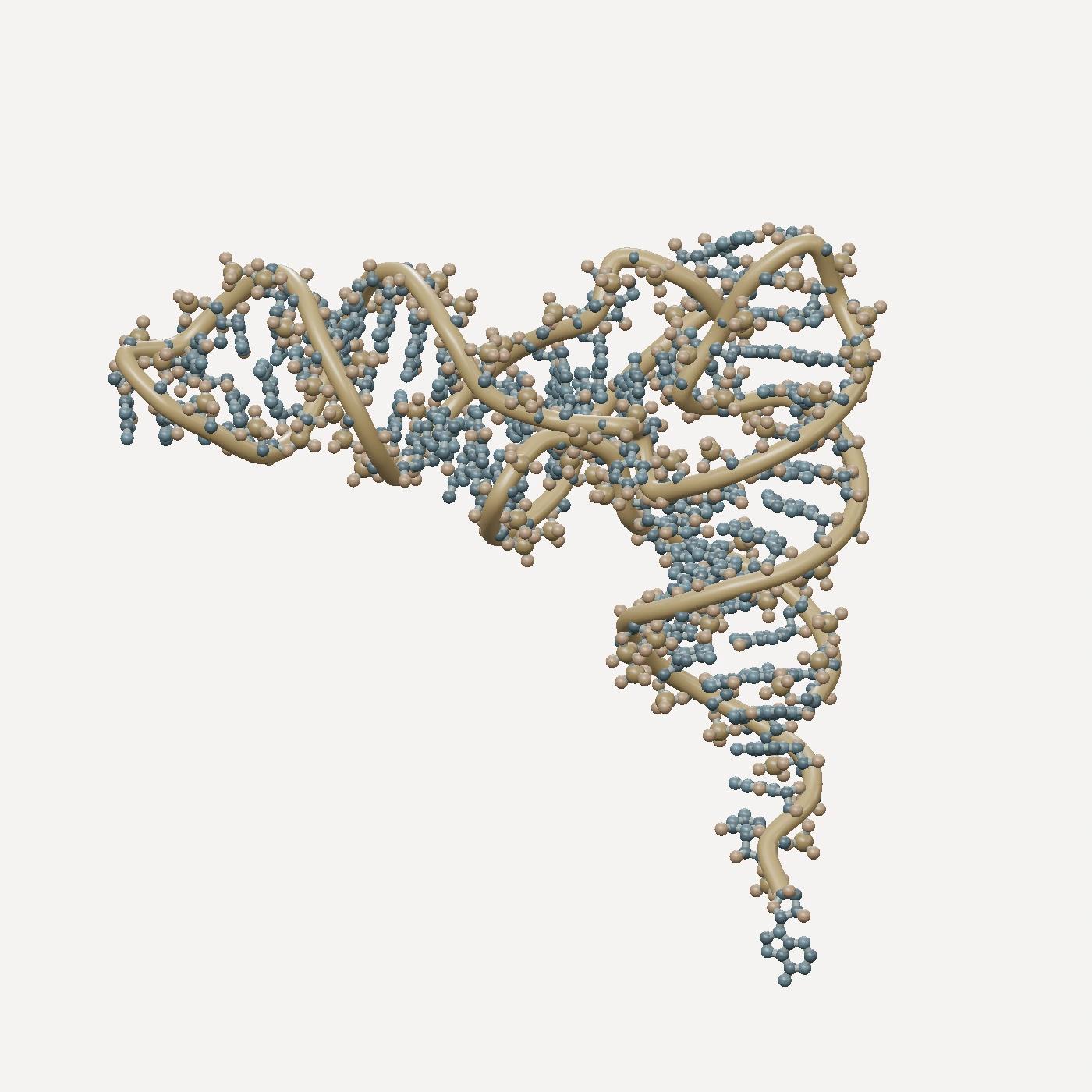
A sequence becomes a structure.
RNA folds into a three-dimensional form. Here, the backbone of a transfer RNA brings distant parts of its sequence together into one molecular structure.
Yeast phenylalanine tRNA · PDB 1EHZ06
Biology is full of leaky abstractions.
An abstraction leaks when details it was meant to hide become necessary to predict the system’s behavior. In a cell, inhibiting one protein can trigger feedback that increases its production or redirects activity through another pathway. The intervention changes the conditions under which it operates. A molecular interaction measured in isolation therefore tells us only part of what will happen in a living system. Reliable design requires understanding these dependencies well enough to establish when a component’s behavior can be treated independently, and when the surrounding system must be considered.5
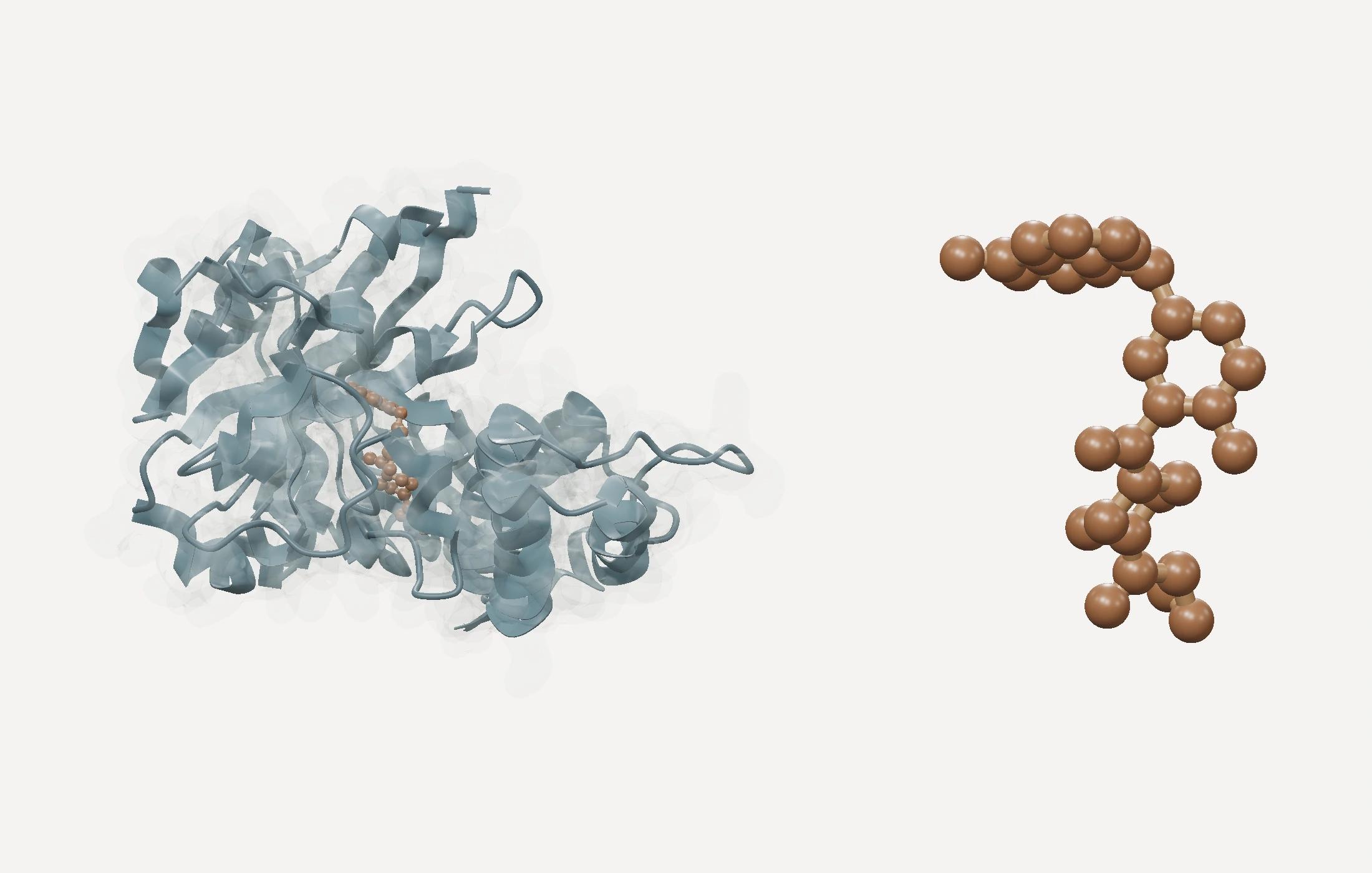
Function depends on an interaction.
A small molecule sits within a protein’s binding pocket. The deposited structure of PARP1 with olaparib makes this interaction visible, from the protein’s fold to the molecule it recognizes.
Experimental complex · PDB 7AAD07
Targeting the right cells.
We believe targeting is the fundamental challenge in biology today. At Kosha, we want control over which cells and tissues a medicine reaches and where it acts within them. Our work begins with ionizable lipids and lipid nanoparticle formulations, designed around the payload and the cells we intend to target.
That control is essential to making molecular design useful in medicine. A peptide may bind its target tightly but struggle to cross a cell membrane. A small molecule may enter cells without reaching sufficient concentrations in the intended tissue. Even the most precise gene editor cannot correct a mutation in cells it never reaches.6
We study how lipid structure and formulation influence which cells take up a payload, how much is released inside them, and how well the system is tolerated. Our goal is to make cell and tissue targeting a property we can design for, opening more of biology to therapeutic intervention.
Targeting across scales
From tissue to molecular target.
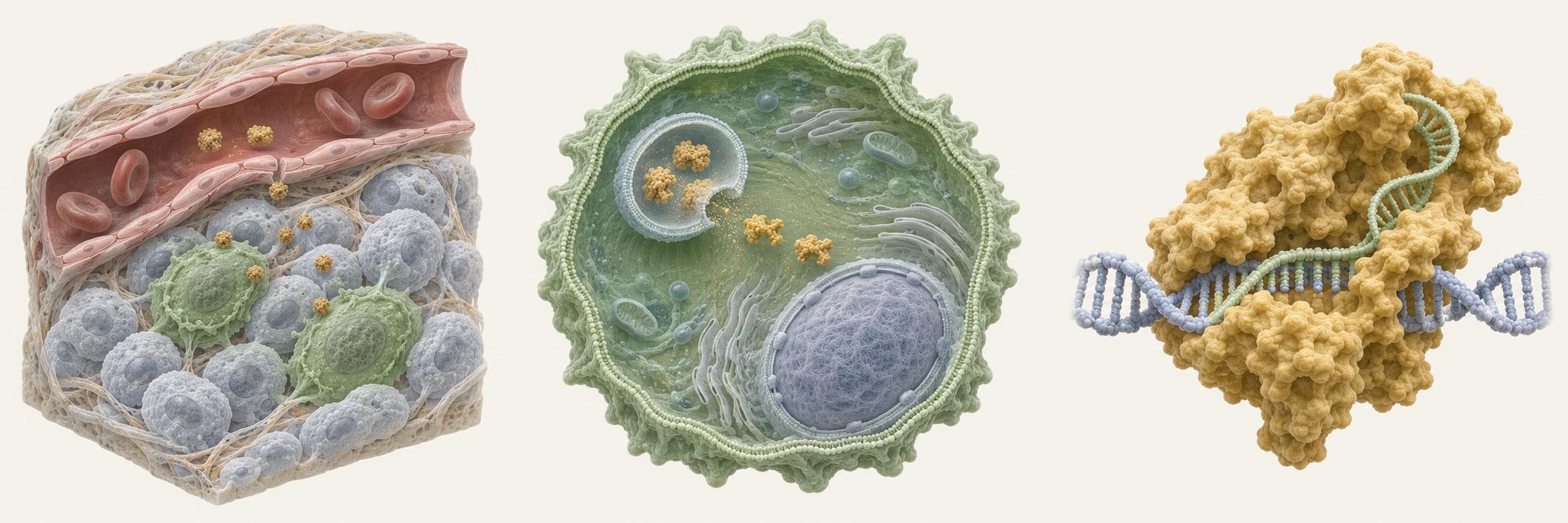
The tissue
Where does it go?
Reach the tissue where the therapeutic is needed.
The cell
Which cells can use it?
Enter the intended cells and release the payload inside them.
The molecular target
Can it reach its site of action?
For a gene editor, reach the DNA sequence it is designed to act on.
An illustrative gene-editing payload connects these scales. Tissue distribution, cellular uptake, and access to DNA are distinct requirements for the intended biological effect.
Conceptual illustration · Different magnifications · Not to scaleView full-size illustrationEstablish control over cellular targeting.
Develop ionizable lipids and formulations for defined payloads and target cells. Through controlled experiments, establish which design choices improve targeting and intracellular availability, which introduce toxicity, and how those relationships change across payloads and biological settings.
Extreme co-design of the therapeutic system.
A payload’s activity and stability affect how much must reach a cell; its physical properties affect how it can be formulated and delivered. We want those dependencies to guide the design of the therapeutic components, delivery chemistry, and formulation from the outset.
Developing real precision medicines.
Our longer-term goal is to specify increasingly complex biological functions and design molecular systems that perform them with a high first-pass success rate. With that level of predictive control, advancing a candidate would require far fewer rounds of in vitro and in vivo experimentation. Experimental work could focus on validating the design’s performance, with much less iteration needed to achieve the intended effect.
08
Design at every biological scale.
For a gene-editing medicine, the editor and guide RNA determine target recognition and editing activity, while the delivery formulation influences which cells receive them and their availability inside those cells. Changing the editor’s activity can change the exposure required to achieve an edit, which in turn changes the demands on delivery. These relationships are the basis of our approach to co-design. We study sequence, molecular structure, and formulation together, evaluating each choice against the intended cellular response. The aim is to understand how a change at one scale affects what we can achieve at another.
- Medicines
- Engineered cells and integrated therapies combine these capabilities around an intended effect in a person.
- Cellular behavior
- The proteome and regulatory networks form the environment in which those functions operate, sharing resources and responding to one another.
- Machinery
- Proteins perform functions: binding a target, catalyzing a reaction, or recognizing a signal. Each function needs an understood operating context.
- Instructions
- RNA and genetic regulation specify what a cell makes. Gene editing can change the DNA from which those instructions are read.
- Chemistry
- Small molecules and lipids provide interactions we can measure and use—the primitive operations of a biological design.
09
Learning to design biological function.
We combine foundational research in generative modeling with expertise in molecular engineering and experimental biology. Our focus is on learning how molecular changes alter biological function, and how those relationships depend on the cellular environment. We want models that can use this knowledge to propose designs for a specified effect and carry what they learn from one biological setting into another. That ability to generalize is essential if each new medicine is to benefit from the work that came before it.
10
Building the experimental foundation.
Whether those relationships carry into a new biological setting has to be established experimentally. We need controlled comparisons that test where a model’s predictions hold and help explain where they fail. That requires knowing precisely what was made, how it was prepared, and under which conditions it was measured. In a delivery experiment, for example, a lipid’s apparent activity can change with its purity or formulation. We are building the experimental infrastructure to distinguish those effects and connect the results back to molecular design, giving each subsequent model a better account of what produced the observed response.
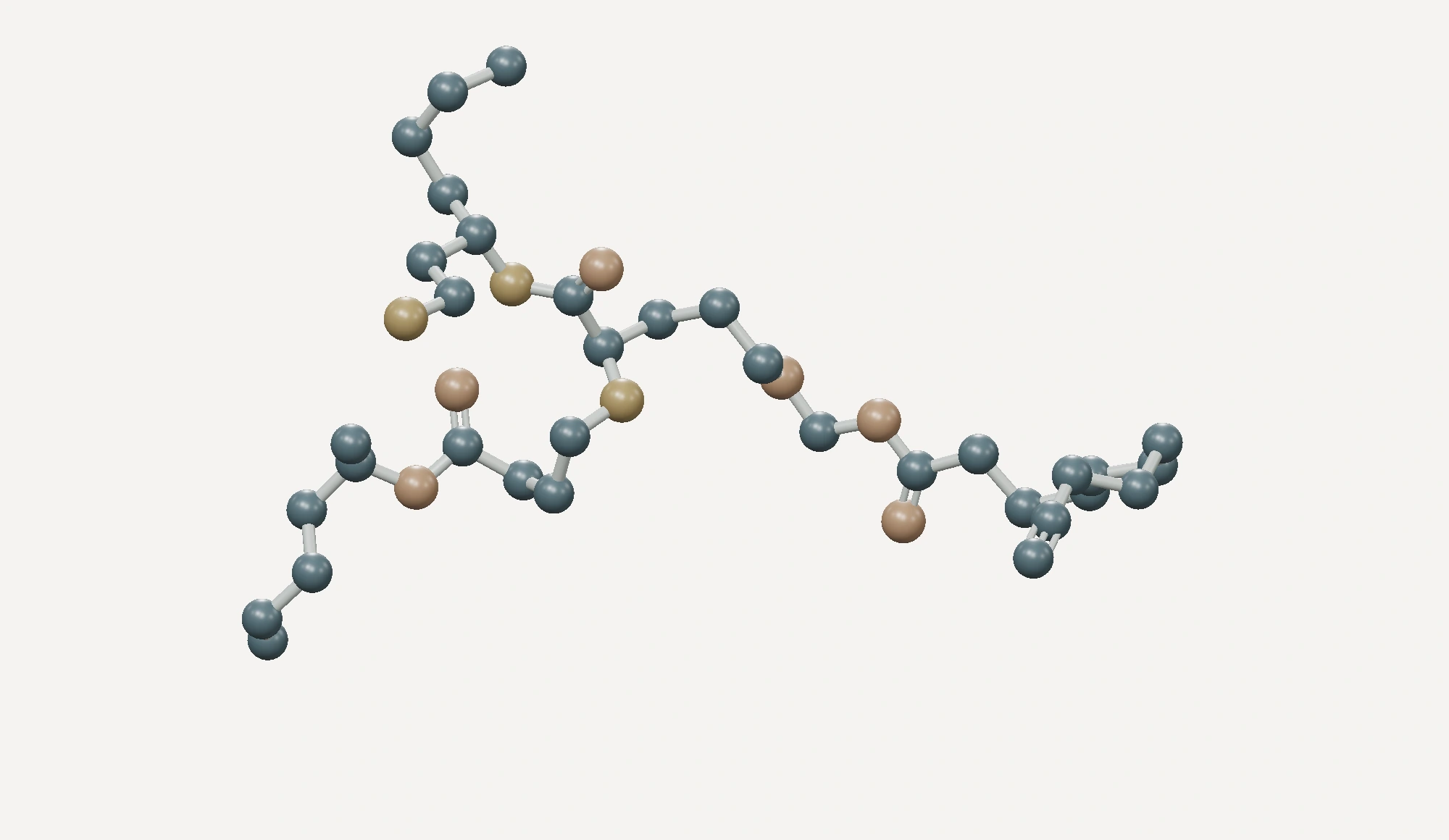
An ionizable lipid.
Delivery introduces another molecular design problem. A lipid’s chemical structure is one part of a formulation whose performance must be measured with its cargo in the intended biological setting.
Computed conformer · Hydrogens omitted11
The work ahead.
Reliable abstractions allow software to grow far beyond what any one person could design at the level of individual circuits. We are working to make that kind of abstraction possible in biology: functions that can be specified, combined, and reused, with understood conditions under which they behave as intended. Those abstractions would let us design increasingly complex biological systems while maintaining a dependable relationship between the function we specify and its molecular implementation.
Let’s reprogram biology, line by line.